Why Performance Marketing Is Eating Itself
The channels that promised measurable ROI on every dollar are getting more expensive, less effective, and harder to attribute. The math that built a generation of D2C brands no longer works.
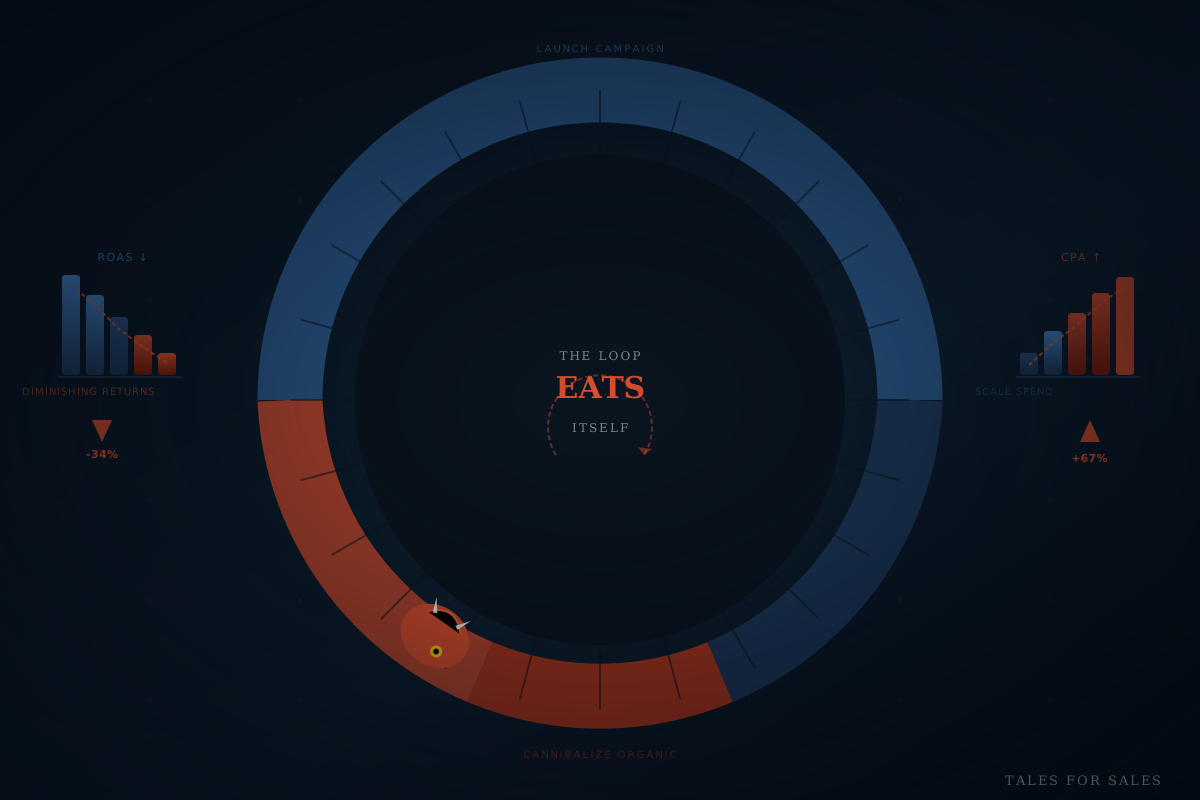
For the better part of a decade, the formula was elegant. Buy Facebook ads. Target precisely. Measure everything. Optimize daily. Scale the winners. Cut the losers. Print money.
Between 2014 and 2020, this formula built an entire generation of direct-to-consumer brands. Warby Parker, Allbirds, Casper, Glossier — they all grew on the back of cheap, targeted, measurable digital advertising. Customer acquisition costs were low. Attribution was clear. The funnel was a machine.
That machine is breaking down. And the companies that built their businesses on it are scrambling to figure out what comes next.
The Numbers Tell the Story
The cost of acquiring a customer through paid digital channels has increased roughly 222% over the past eight years. In 2017, the average cost per thousand impressions (CPM) on Facebook was $5.12, according to data compiled by Revealbot. By early 2025, that figure exceeded $14 in most competitive categories. Google Ads tell a similar story — average cost per click across all industries rose from $1.16 in 2018 to $4.22 in 2024, according to WordStream.
But cost is only half the problem. Effectiveness is declining simultaneously.
Meta's average click-through rate for Facebook Ads dropped from 0.9% in 2020 to 0.72% in 2024. Instagram ad engagement fell even faster. Google Shopping ads, once the backbone of e-commerce acquisition, saw conversion rates decline by roughly 15% between 2022 and 2025 across major retail categories.
The result is a vise: brands are paying more per impression while getting less response per dollar. The economics that made D2C viable — acquire a customer for $30, generate $120 in lifetime value — have inverted for many brands. Acquisition costs now regularly exceed first-order revenue.
What Broke
Three structural shifts converged to create this reality.
Privacy killed precision targeting. Apple's App Tracking Transparency (ATT) framework, launched with iOS 14.5 in April 2021, was the single most disruptive event in digital advertising history. When given the choice, 96% of iPhone users opted out of tracking, according to Flurry Analytics. Overnight, Facebook lost the ability to track users across apps and websites — the mechanism that made its targeting so precise and its attribution so clean.
The impact was immediate. Meta reported a $10 billion revenue hit in the year following ATT. Smaller advertisers — the D2C brands that depended on Facebook's targeting — felt it even more acutely. Without cross-app tracking, lookalike audiences became less accurate, retargeting pools shrank, and attribution models went dark.
Google's deprecation of third-party cookies in Chrome, finally enacted in early 2025 after years of delays, applied the same pressure to the open web. The targeting infrastructure that powered performance marketing for a decade was dismantled in less than three years.
Platform saturation drove competition. In 2015, a relatively small number of sophisticated advertisers were buying Facebook and Google ads. By 2023, even the local pizza shop was running retargeting campaigns. The total number of active advertisers on Meta's platforms exceeded 10 million. On Google Ads, it was over 8 million.
When everyone is bidding for the same attention, prices rise. That's basic auction economics. But the attention supply didn't grow proportionally. Daily active users on Facebook plateaued in North America and Europe. Instagram's growth slowed. The number of advertisers bidding grew faster than the number of eyeballs available, compressing returns for everyone.
Consumer resistance hardened. There's a subtler shift underneath the structural changes: people got better at ignoring ads. Banner blindness, a term coined in the late 1990s, has evolved into a more general advertising immunity. According to a 2024 Edelman study, 72% of consumers said they actively try to avoid online advertising, and 53% said they use ad blockers on at least one device.
The generation raised on targeted advertising treats it like weather — an ambient annoyance to be minimized. They don't click. They don't convert. They scroll past.
The Attribution Crisis
When performance marketing worked, its greatest selling point was measurability. Every dollar could be traced to a click, a conversion, a revenue event. CMOs could show the board a dashboard with clear ROI numbers.
That story was always more fiction than reality. Even before ATT, last-click attribution — the default model for most advertisers — systematically overcredited the final touchpoint and undercredited everything that came before. A customer might see 15 brand impressions across Instagram, YouTube, a podcast, a friend's recommendation, and a Google search before finally clicking a retargeting ad. Last-click attribution gave 100% of the credit to that retargeting ad.
Now, with tracking degraded, even that flawed picture has gone blurry. Marketing mix modeling (MMM) — the pre-digital technique of using statistical analysis to estimate channel impact — is making a comeback. Companies like Google and Meta are actively promoting their own MMM tools, which is a remarkable admission that the click-level attribution they sold for a decade no longer functions.
The problem with MMM is that it requires significant spend across multiple channels to generate statistically meaningful results. A brand spending $50K per month across three channels can't do credible MMM. It's a tool for enterprises, not startups.
This leaves mid-market brands in the worst position: the precision targeting that let them compete with larger companies is gone, and the measurement tools that work without tracking are designed for budgets they can't match.
The Brands That Saw It Coming
Not every brand was caught off guard. Several high-profile companies pivoted before the crisis peaked.
Airbnb's decision to shift from performance to brand marketing in 2021 has become the most-cited example. Brian Chesky, Airbnb's CEO, told investors that the company had reduced performance marketing spend by 28% and redirected that budget to brand campaigns — PR, content, and partnerships. The result: Airbnb's marketing spend as a percentage of revenue dropped from 24% in 2019 to 18% in 2023, while revenue grew from $4.8 billion to $9.9 billion.
The implicit lesson: Airbnb was overspending on performance marketing, and much of that spend was acquiring customers who would have found the platform anyway. The incremental value of performance spend had been declining for years, masked by attribution models that gave paid channels credit for organic demand.
Allbirds went the opposite direction. The shoe company doubled down on performance marketing as costs rose, borrowing to fund customer acquisition. By 2024, Allbirds' stock had fallen 97% from its IPO price, and the company was burning cash at an unsustainable rate. Its customer acquisition cost had risen faster than its average order value. The D2C math that made the company a darling in 2018 had become its death sentence by 2024.
What Replaces Performance Marketing
The honest answer is: nothing replaces it cleanly. Performance marketing offered something no other channel could — measurable, scalable, immediate customer acquisition. The alternatives are slower, harder to measure, and require different skills.
Brand marketing builds demand over time rather than harvesting demand that already exists. It works, but the payoff horizon is months or years, not days. Most companies lack the patience and the financial runway.
Content and SEO generate compounding returns but require sustained investment before they pay off. A blog post published today might not rank for six months. A YouTube channel might take two years to build enough subscribers to drive meaningful traffic.
Community and word-of-mouth are the most efficient acquisition channels when they work — zero marginal cost per customer — but they're nearly impossible to manufacture. You can't force virality or buy authentic recommendations.
Partnerships and distribution deals offer reach without the auction dynamics of paid media, but they require negotiation, relationship management, and often margin-sharing.
The pattern emerging among the most successful post-performance-marketing brands is a portfolio approach: 40-50% brand marketing, 20-30% content and SEO, 15-20% performance marketing (used surgically, not as the primary channel), and 10-15% community and partnerships. The exact mix varies by category, stage, and margin structure.
The Deeper Problem Nobody Discusses
Performance marketing's decline reveals something uncomfortable about how many companies operate: they never had real product-market fit.
When you can acquire customers cheaply and target precisely, you can build a business on marketing efficiency alone. The product doesn't need to be great. It needs to be adequate. The margin between acquisition cost and lifetime value provides room for mediocrity.
Remove the cheap acquisition, and the truth emerges. If your product doesn't generate organic word-of-mouth, repeat purchases, and genuine loyalty, no amount of marketing spend — performance or otherwise — will save you. Marketing can accelerate something that already works. It cannot make something broken work.
The companies that will thrive in the post-performance era are the ones that would have survived without performance marketing in the first place. They have products people talk about. They have margins that support brand investment. They have customer relationships that extend beyond the transaction.
Performance marketing didn't create growth. It borrowed it from the future. And the bill is coming due.
 Advertisement