The Marketing Funnel Is Dead. What Replaced It Is Messier.
For a century, marketers organized their world around a tidy funnel: awareness, consideration, purchase. The actual customer journey looks nothing like that anymore.
The marketing funnel was invented in 1898. Elias St. Elmo Lewis, an advertising executive, proposed that customers move through a linear progression: Attention, Interest, Desire, Action. AIDA. Neat. Logical. Fits on a whiteboard.
One hundred and twenty-seven years later, most marketing organizations still structure their teams, budgets, and measurement around this model. There's a top-of-funnel team. A mid-funnel team. A bottom-of-funnel team. Each has its own KPIs. Each justifies its own budget.
The problem is that customers don't move through funnels anymore. They probably never did, but the illusion held as long as brands controlled the information. They don't control it now.
How People Actually Buy Things
Google's research division published a study in 2020 called "Decoding Decisions" that tracked how consumers actually make purchase decisions. The findings demolished the funnel model.
The research identified what they called the "messy middle" — a chaotic space between the initial trigger (recognizing a need) and the actual purchase. In this space, consumers don't move linearly. They loop between two mental modes: exploration (expanding options) and evaluation (narrowing options). They loop repeatedly, unpredictably, for days or months.
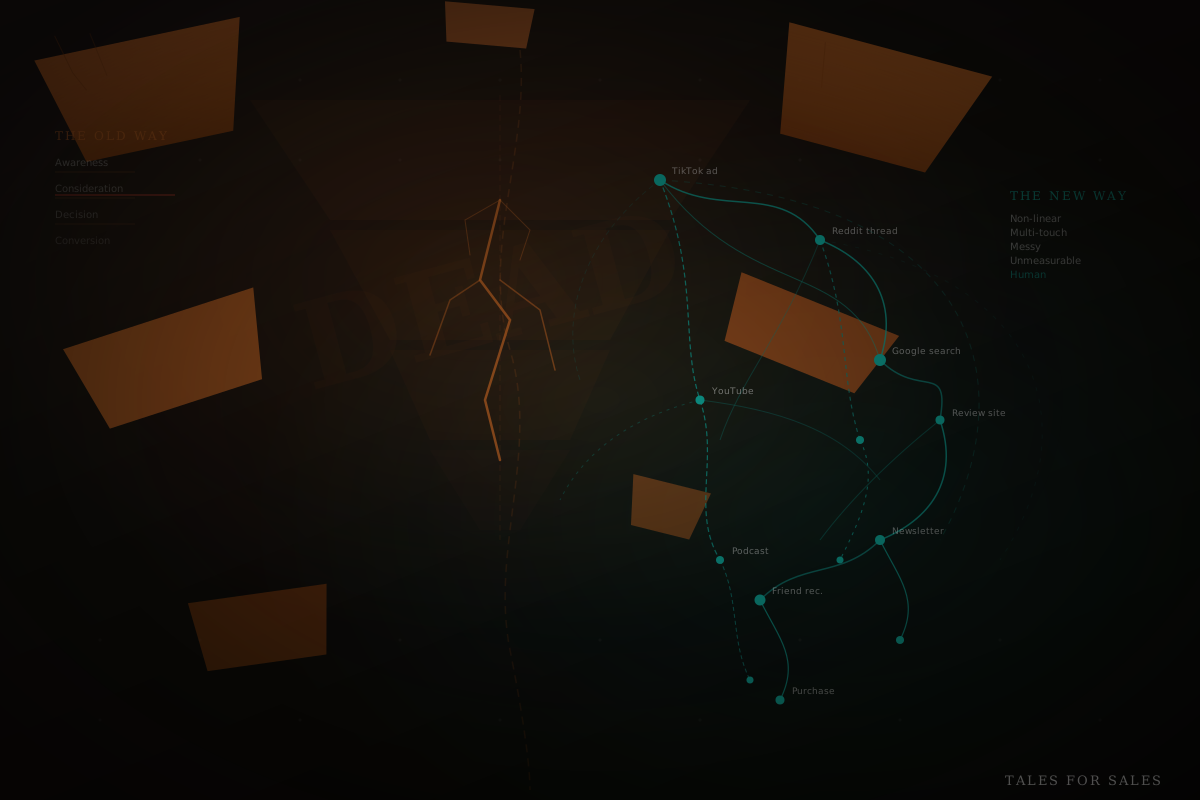
A person researching running shoes might start with a Google search, read a Reddit thread, watch three YouTube reviews, see an Instagram ad, ignore the ad, visit two brand websites, read a comparison blog post, ask a friend, see a different Instagram ad, click it this time, abandon the cart, get a retargeting email, ignore the email, go to a store to try shoes on, leave without buying, read one more Reddit thread, and then buy the shoes directly from the brand's website at midnight on a Tuesday.
That journey touches 15+ touchpoints across six channels over three weeks. No funnel model captures it. And no attribution system measures it accurately.
Why the Funnel Persisted This Long
If the funnel doesn't describe reality, why did marketing cling to it for so long?
Three reasons.
Organizational convenience. Funnels give teams clean ownership. Awareness is owned by brand marketing. Consideration is owned by content. Conversion is owned by demand gen. This clarity makes budget allocation easy, performance reviews simple, and turf wars predictable. The funnel isn't a theory of customer behavior. It's an org chart.
Measurement simplicity. When each stage has its own metrics — impressions for awareness, engagement for consideration, conversions for decision — everyone can demonstrate impact. The CMO shows the board that impressions are up 30%. The demand gen director shows that MQLs are up 15%. Everyone gets credit. Nobody asks whether impressions actually caused MQLs.
Platform reinforcement. Facebook, Google, and LinkedIn all built their advertising products around funnel stages. Campaign objectives map to funnel positions: "Awareness" campaigns, "Consideration" campaigns, "Conversion" campaigns. The platforms benefit from the funnel model because it justifies spending across multiple campaign types. If brands stopped thinking in funnel stages, they might realize they could cut half their campaigns.
What the Data Shows
The Ehrenberg-Bass Institute — the research group whose work on brand science has influenced companies like Mars, Procter & Gamble, and Coca-Cola — has spent decades studying how consumers actually make purchase decisions. Their findings consistently contradict the funnel.
Most purchases involve little to no "consideration." Professor Byron Sharp's research shows that for most consumer categories, buyers make decisions from a small set of brands they already know. They don't evaluate. They don't compare. They grab what comes to mind first. Sharp calls this "mental availability" — the probability that a buyer will think of your brand in a buying situation.
Loyalty is a statistical illusion. Brands don't have loyal customers and non-loyal customers. They have frequent buyers and infrequent buyers, distributed along a curve. Even Coca-Cola's most "loyal" customers buy Pepsi sometimes. The funnel implies that customers move from unaware to loyal in a progression. The data shows they move in and out of purchase behavior based on mental availability and physical availability (distribution).
Brand growth comes from penetration, not frequency. Growing brands acquire new buyers. They don't get existing buyers to buy more. This contradicts the funnel's emphasis on "nurturing" existing leads toward deeper engagement. The most effective growth strategy is reaching more people, not engaging fewer people more deeply.
These findings don't mean the funnel is completely wrong. They mean it describes a small subset of purchases — high-involvement, high-consideration categories like enterprise software, cars, and houses — and misrepresents how the vast majority of consumer decisions actually work.
The Models That Are Replacing It
Several frameworks have emerged to describe post-funnel buyer behavior. None is perfect. All are more honest than AIDA.
Google's Messy Middle — exploration and evaluation loops, as described above — is descriptively accurate but offers limited strategic guidance. It tells you what happens but not what to do about it.
McKinsey's Consumer Decision Journey is a circular model where consumers move from initial consideration to active evaluation to purchase to post-purchase experience, with the potential to loop back at any stage. It's more realistic than the funnel but still implies a structured sequence that many purchases don't follow.
The Orbit Model, proposed by several marketing thinkers, replaces the funnel with gravitational metaphor. The brand sits at the center. Consumers orbit at various distances, sometimes moving closer (engagement), sometimes drifting further (disengagement), rarely following a predictable path. The brand's job is to exert gravitational pull — through content, community, product experience, and cultural presence — rather than pushing people through stages.
The orbit model is the most honest description of how modern brand-consumer relationships work. But it's also the hardest to operationalize. How do you measure orbital distance? How do you attribute a purchase to gravitational pull?
What This Means for How Brands Should Spend
If the funnel is dead, so is the budget model that sits on top of it.
The traditional split — X% on awareness, Y% on consideration, Z% on conversion — assumes that each stage is a separate problem requiring separate spending. The reality is that a single piece of content or a single brand impression can simultaneously build awareness, inform consideration, and trigger purchase. A YouTube video review might be the first time someone encounters your brand, the information that helps them evaluate it, and the push that sends them to your website to buy.
The more productive framework is to allocate budget by reach and frequency rather than by funnel stage:
Reach budget — content and media designed to put your brand in front of as many potential buyers as possible. This replaces "awareness" spending but is measured differently: not impressions, but the percentage of your total addressable market that encountered the brand in a given period.
Memory budget — repeated, distinctive brand impressions that build mental availability. This replaces "consideration" spending. The goal isn't to move people down a funnel. It's to ensure they remember you when a buying trigger occurs.
Activation budget — direct response mechanisms (search, retargeting, promotions) that capture existing demand. This replaces "conversion" spending. It's the smallest budget because it only harvests demand that the other two budgets created.
The Uncomfortable Implication
Here's the part that makes marketers nervous: if there's no funnel, there's no nurture sequence. No elaborate email drip that "moves prospects through stages." No MQL-to-SQL handoff that justifies the marketing team's headcount. No neat dashboard showing how this month's blog posts created next quarter's revenue.
The post-funnel world requires comfort with ambiguity. Brand investments will never attribute cleanly. The effect of a YouTube video on a purchase that happens three months later via a Google search cannot be traced with certainty. The influence of a Reddit comment on a B2B deal closed by a salesperson will never show up in a CRM.
This doesn't mean brand investment doesn't work. It means the measurement infrastructure the industry built over the past decade — attribution platforms, multi-touch models, data clean rooms — was designed for a world that no longer exists.
The companies adapting fastest are the ones that have accepted this. They run incrementality tests instead of attribution models. They measure brand lift surveys instead of last-click conversions. They look at blended CAC instead of channel-level CAC.
And they've stopped pretending that their customers move through funnels. Because customers never read the whiteboard.
 Advertisement