The Parasocial Economy: When Feeling Close to Strangers Becomes a Business Model
From Patreon to merch drops to paid Discord servers, the creator economy runs on one-sided emotional relationships. What happens when the audience figures out the intimacy was always a product?
In 1956, psychologists Donald Horton and Richard Wohl published a paper describing a phenomenon they called "parasocial interaction" — the one-sided relationship that a television viewer develops with an on-screen personality. The viewer feels a genuine emotional connection. The personality doesn't know the viewer exists.
Horton and Wohl studied this in the context of mid-century TV hosts like Arthur Godfrey, who spoke directly to the camera with a warmth that made viewers feel he was talking to them personally. They noted that viewers would discuss these hosts as if they were friends, defend them in arguments, and experience genuine distress when the hosts changed or left their shows.
Sixty-eight years later, the parasocial dynamic has become the foundational economic model of the internet's fastest-growing industry. The creator economy — estimated at $250 billion globally — is, in its essence, an economy built on manufactured intimacy.
The Architecture of Closeness
Modern creators don't just produce content. They produce the feeling of a relationship. This isn't accidental — it's a design pattern that every successful creator consciously or unconsciously follows.
The pattern has consistent elements. Direct address: the creator speaks to the camera as if speaking to an individual, not a crowd. Personal disclosure: they share details about their daily life, emotions, struggles, and relationships that create a sense of access to their "real" self. Reciprocity signaling: they acknowledge their audience by name, respond to comments, and reference viewer messages in their content.
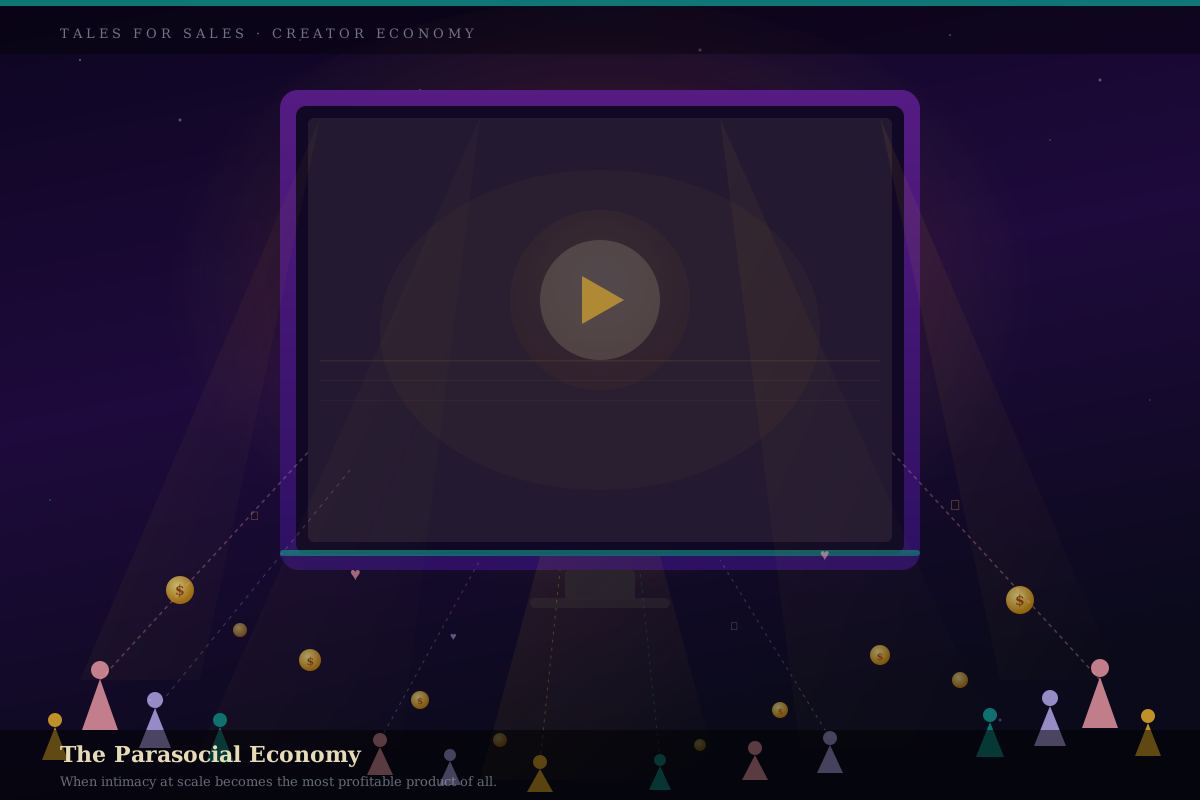
The most sophisticated creators build layered intimacy tiers that correspond to revenue tiers. Free YouTube content feels personal. A $5/month Patreon tier gets you behind-the-scenes content that feels more personal. A $25/month tier gets exclusive Discord access where you might actually interact with the creator. A $500 one-on-one video call is the ultimate parasocial purchase: a few minutes of the real relationship.
Each tier monetizes a deeper level of perceived intimacy. The audience ascends not by receiving proportionally more content, but by receiving content that feels proportionally more private.
The Business Model Nobody Names
No successful creator describes their business model as "monetizing one-sided emotional relationships." The language used is softer: community, connection, supporting the work, exclusive content, early access.
But the economics are clear. A creator with one million YouTube subscribers and a two percent conversion rate to a $5/month membership earns $100,000 per month. The value proposition of that membership is almost never the exclusive content — most paid content isn't meaningfully different from free content. The value proposition is a closer relationship with the creator.
Merchandise operates the same way. A $35 hoodie with a creator's logo is not a $35 hoodie. It's an identity signal: I belong to this community. I have a relationship with this person. The markup over a generic hoodie represents the emotional premium.
Super chats on YouTube, bits on Twitch, gifts on TikTok — all of these are mechanisms for purchasing a moment of acknowledgment. The viewer pays money, their name appears on screen, the creator says it aloud or reacts, and the viewer experiences a flash of recognition from someone they've watched for hundreds of hours.
The transaction is not content for money. It's acknowledgment for money. And in a world where loneliness has been declared a public health epidemic by the US Surgeon General, acknowledgment is a product with enormous demand.
When the Audience Figures It Out
Parasocial economies work as long as the audience maintains the emotional illusion. When that illusion breaks, it breaks violently.
Creator burnout often triggers the break. When a YouTube creator posts a tearful video explaining that they need to take a break from daily uploads for their mental health, the sympathetic comments exist alongside a more revealing reaction: betrayal. "But we need you." "I was counting on this video today." "You owe us — we pay your salary."
These reactions reveal what the transactional subtext was all along: the audience was paying for emotional access, and the creator's boundary violation — prioritizing their own wellbeing — feels like a breach of contract.
Scandal triggers it more dramatically. When a beloved creator is revealed to have behaved badly in private — and this happens with predictable regularity — the audience's reaction isn't proportional to the offense. It's proportional to the perceived betrayal: "You let me into your life, and the person I thought I knew was a lie."
The intensity of parasocial backlash consistently exceeds what would be rational for someone who had never met the creator. But the emotional relationship was real for the viewer, even if it was unilateral. And the business model that encouraged and monetized that emotional investment is the same model that makes the backlash so devastating when it arrives.
The Marketing Implications
Brands have been trying to replicate the parasocial model for years, mostly by adopting first-person, personality-driven social media presences. Wendy's roasts people on Twitter. Duolingo's owl has a character arc on TikTok. Scrub Daddy's sponge has a more active social life than most humans.
These strategies work because they borrow the parasocial framework without the vulnerability of a real person. A brand mascot can't have a scandal. An anthropomorphized product can be funny without the audience developing the kind of deep emotional attachment that leads to parasocial betrayal.
But brands also sponsor real creators, and this is where the parasocial economy creates genuine risk. When a brand partners with a creator, it's not just buying an audience — it's buying a parasocial relationship. If the creator maintains the illusion, the brand benefits from the warmth of fake intimacy. If the illusion breaks, the brand is associated with the fallout.
The smarter brand strategies increasingly focus on what might be called "parasocial-adjacent" marketing: building community spaces where customers feel genuine connection to each other (not to a manufactured persona), creating content that's useful rather than intimate, and investing in product quality that generates organic advocacy from people with no financial incentive.
The Ethical Question Nobody Asks
The parasocial economy raises an ethical question that the creator industry has been remarkably successful at avoiding: is it ethical to systematically manufacture the feeling of intimacy for commercial gain?
The standard defense is autonomy: viewers are adults making informed choices. Nobody forces anyone to pay for a super chat or a Patreon membership. The creator is transparent about the fact that they're producing content as a business.
But transparency about the business model doesn't make the parasocial dynamic consensual in any meaningful sense. The emotional attachment that drives purchasing behavior is not a choice — it's a psychological response to carefully designed stimuli. The viewer didn't choose to feel close to the creator any more than they chose to feel hungry when they smelled food.
This doesn't make the parasocial economy inherently exploitative. But it does make it worth examining with the same rigor we apply to other industries that monetize psychological vulnerabilities: gambling, social media algorithms, and pharmaceutical marketing.
The creators and brands that thrive long-term in this economy will likely be the ones that acknowledge the dynamic honestly, set reasonable boundaries with their audiences, and resist the temptation to extract maximum revenue from manufactured emotional attachment. Not because it's legally required — it isn't — but because the alternative, scaled parasocial exploitation, eventually produces the backlash that destroys what was built.
 Advertisement