Cancel Culture Made Brands Boring. And That's a Strategic Problem.
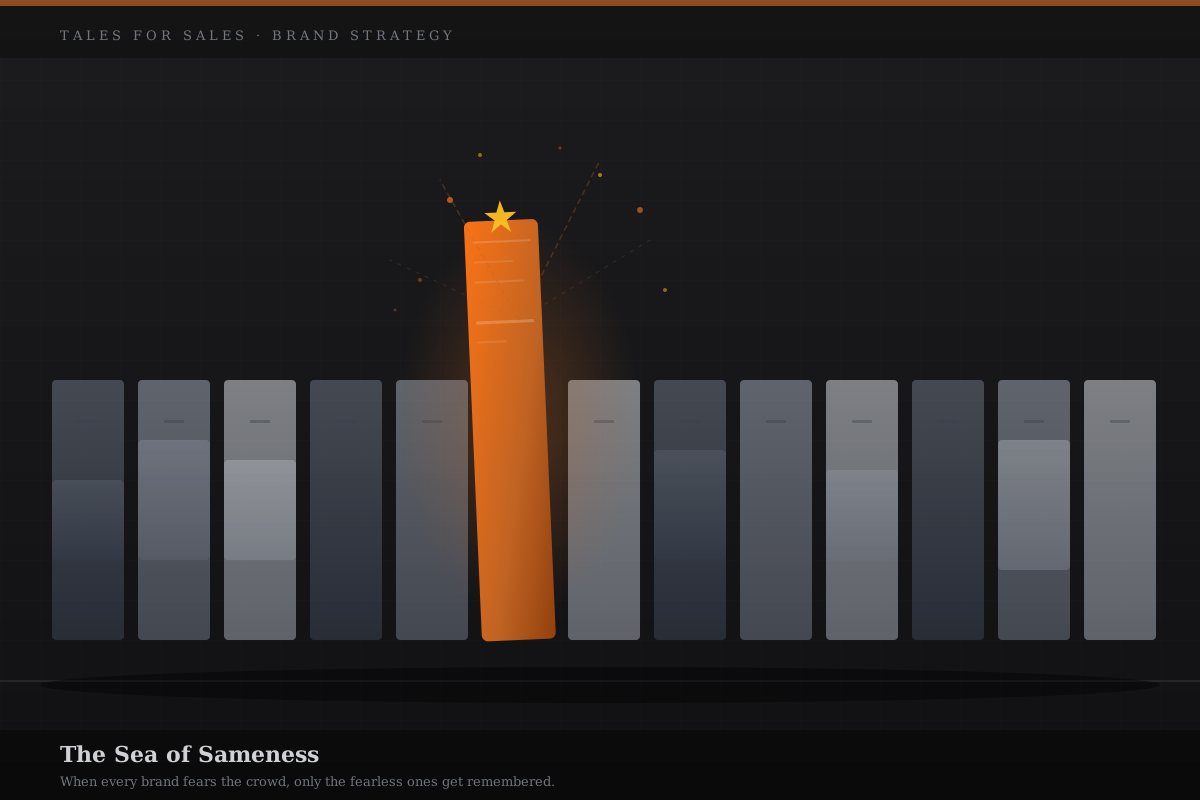
Fear of backlash has pushed most brands into a narrow band of safe, inoffensive communication. The result: a sea of sameness where no brand says anything memorable. The companies winning now are the ones willing to be disliked.
In 2017, Pepsi released an ad featuring Kendall Jenner walking through a vaguely defined protest, handing a can of Pepsi to a police officer, and apparently solving systemic injustice with carbonated sugar water. The backlash was immediate, universal, and merciless. Pepsi pulled the ad within 24 hours and issued an apology that apologized for nothing specific.
The ad was genuinely bad. Tone-deaf, trivializing, and clearly produced by people who had never attended a protest. It deserved criticism. But the aftermath extended far beyond Pepsi. The incident became a case study that every major brand's legal and marketing teams studied, and the lesson most of them took away was: do not take positions. Do not reference culture. Do not say anything that anyone might find offensive.
Seven years later, that lesson has calcified into an industry-wide strategic problem.
The Safety Trap
Walk through any category — banking, insurance, automotive, telecom, consumer packaged goods — and try to distinguish one brand's advertising from another's. You will struggle. Not because the products are identical, but because the communications are.
The typical large-brand ad in 2025 features: a diverse cast of attractive people, upbeat music, nature footage or urban lifestyle shots, a vague statement about empowerment or togetherness, and a logo. It says nothing specific. It takes no position. It risks nothing. And it's completely forgotten within seconds of viewing.
This isn't a creative failure — it's a strategic choice driven by fear. Corporate communications teams, legal departments, and risk-averse CMOs have collectively decided that the safest path is the one that offends nobody. And because social media can amplify any misstep into a crisis, the definition of "offensive" has expanded to include almost anything with a discernible point of view.
The result is what brand strategist Martin Weigel calls "wallpaper advertising" — communications so bland that they're functionally invisible. The brand spends millions on production and media, and the audience's brain processes the message the same way it processes the pattern on a hotel room wall: present, technically visible, utterly ignored.
The Math of Being Forgettable
There is a measurable cost to being boring. Byron Sharp's research at the Ehrenberg-Bass Institute has consistently shown that brand growth depends on mental availability — the probability that a consumer thinks of the brand in a buying situation. Brands that fail to create distinctive, memorable impressions become mentally unavailable, regardless of how much they spend on media.
In other words: a brand that spends $50 million on advertising that nobody remembers has functionally spent $50 million on nothing. The media investment bought reach, but the creative execution failed to convert that reach into memory. The brand achieved awareness without salience — people saw the ad but couldn't tell you what it was for.
Research from System1, a company that measures emotional response to advertising, shows that the percentage of ads rated as generating "strong positive emotion" has declined steadily since 2018. More ads are being produced. More money is being spent. And the emotional impact — the thing that actually drives memory formation and brand salience — is going down.
The Brands That Break Through
Against this backdrop of institutional timidity, the brands that achieve cultural resonance tend to share one characteristic: they're willing to be disliked by some people in order to be loved by others.
Liquid Death doesn't appeal to everyone. Its tallboy cans of water with skull graphics and heavy metal branding actively repel people who prefer their water to feel clean and natural. That's the point. By accepting that some consumers will dislike the brand, Liquid Death created a product that the right consumers feel genuine emotional attachment to.
Patagonia takes political positions that alienate a meaningful percentage of potential customers. But the customers who remain are more loyal, more engaged, and more likely to advocate for the brand. The trade-off is intentional: trading breadth for depth.
Even within conventional categories, the brands that stand out tend to be the ones that say something specific enough to be debatable. Apple's "Think Different" was a declaration that implicitly labeled non-Apple users as conventional thinkers. Nike's Colin Kaepernick campaign was a political statement that caused measurable short-term sales losses in some demographics while driving outsized growth in others.
The Strategic Calculus
The fear of cancel culture has distorted the risk calculus for most brands. The perceived cost of a backlash — social media outrage, hashtag campaigns, news cycles — feels enormous and immediate. The cost of being boring — declining brand salience, inability to charge premium prices, gradual market share erosion — feels abstract and distant.
But the data suggests the opposite. Research from the Yale School of Management found that the average consumer boycott has minimal long-term impact on the target company's sales or stock price. Most boycotts last days, not months. Consumer attention moves on. The brand survives.
Meanwhile, the cost of being forgettable compounds silently. Each year of wallpaper advertising is a year of declining mental availability. By the time the decline shows up in market share numbers, it's been building for years and is extremely difficult to reverse.
The companies that navigate this well tend to distinguish between two types of controversy: controversy that comes from taking a genuine position relevant to their brand, and controversy that comes from incompetence or insensitivity. The Pepsi ad was the latter — a clumsy attempt to co-opt culture. Nike's Kaepernick campaign was the former — a deliberate brand choice aligned with its target audience's values.
The Way Forward
The path out of the safety trap isn't to be controversial for its own sake. It's to accept that any communication distinctive enough to be remembered will also be specific enough to be criticized.
The brands that break through in the current environment tend to do three things. They know exactly who they're for, which means knowing who they're not for. They say things that are specific and debatable rather than vague and inoffensive. And they accept that a percentage of negative reactions is the cost of generating any reaction at all.
In a world where most brands have optimized for safety, being memorable is itself a form of competitive advantage. The bar has never been lower. Any brand willing to say something real, take a genuine position, or create work that provokes any emotion beyond indifference will stand out — not because they're brilliant, but because everyone else has voluntarily opted out of the conversation.
 Advertisement